 Live Chat



.png)





Written by: Joblogic
What is a PAT test certificate?
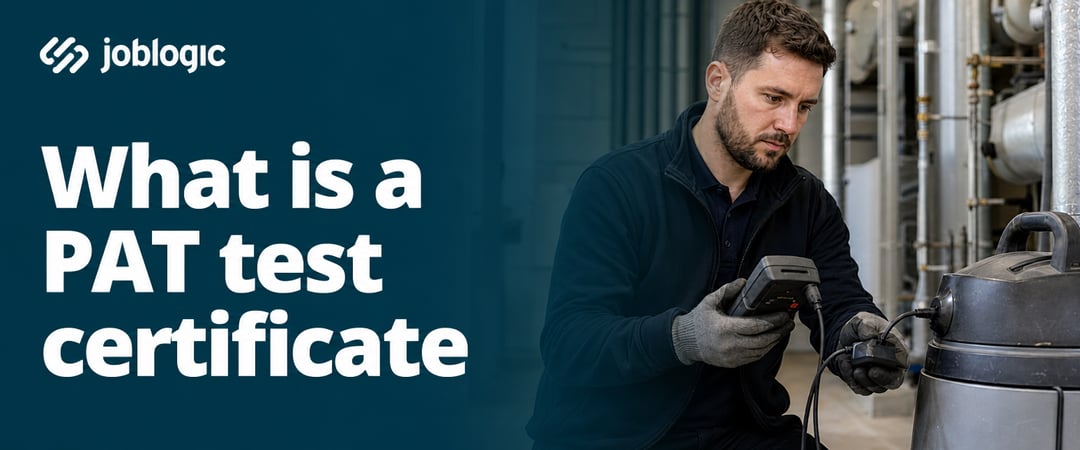
A Portable Appliance Testing (PAT) test certificate is an official document confirming that a portable electrical appliance has been inspected, tested, and found safe to use. It records the outcome of both a visual inspection and a set of electrical tests carried out by a competent person.
PAT testing covers two distinct checks. The first is a visual inspection for obvious signs of damage, such as frayed cables or cracked casings. The second involves electrical tests that measure specific values, including earth continuity and insulation resistance.
No formal qualification is required by law to carry out a PAT test. The person testing must be competent through relevant training or practical experience. Competence is assessed by the duty holder, not a licensing body.
Knowing what a certificate is only gets you so far. The reason most businesses take PAT testing seriously comes down to what happens without it.
Why PAT test certificates matter for your business
UK law does not name a specific PAT certificate as mandatory. Several pieces of legislation place a clear duty on employers and landlords to keep electrical equipment safe, and a certificate is the most widely accepted way to demonstrate that duty has been met.
Many insurers ask for PAT records as a condition of cover. Without them, a claim linked to an electrical fault can be refused. When a client, local authority, or auditor asks for evidence, a Contract Manager with organised records can respond immediately. Without them, it's a scramble to piece things together while the request is already sitting on the desk.
Legal compliance and employer responsibility
Three pieces of UK legislation shape the compliance picture for PAT testing:
- Electricity at Work Regulations 1989: requires all electrical equipment to be maintained to prevent danger
- Health and Safety at Work Act 1974: places a general duty on employers to protect employees and anyone else affected by their work
- Provision and Use of Work Equipment Regulations 1998 (PUWER): requires that work equipment is suitable, maintained, and regularly inspected
None of these laws name PAT testing directly. Together, they create a legal expectation that electrical equipment is checked regularly and that documented proof exists. A PAT certificate in the UK is that proof, and for electrical contractors in particular, having no evidence to rely on when a safety incident occurs can mean the difference between business continuity and serious consequences.
What a PAT test certificate should include
Once you understand why these records are required, it helps to know exactly what a complete certificate looks like. A PAT test report without full test readings is not fit for purpose. Those readings are what allow you to verify a result and compare against previous tests to identify deterioration over time.
A properly completed portable appliance test certificate should include all of the following:
- Appliance description: the item name, make, model, and its location within the premises
- Unique asset ID: a reference number matching the label applied to the appliance after testing
- Date of inspection: the date the test was carried out
- Test results: a pass or fail outcome for each electrical test performed
- Specific test readings: the actual measured values, not just a pass or fail summary
- Name and signature of the tester: the competent person responsible for the inspection
- Recommended retest date: based on a risk assessment of the appliance type, usage frequency, and operating environment
If you are reviewing a PAT testing form from a contractor, check every field is populated before filing the record. A missing retest date or absent test readings can create compliance gaps that only surface during an audit.
How long does a PAT test certificate last?
There is no single legal expiry date for a PAT certificate in the UK, and there's no fixed interval table in the current guidance either. Retest intervals are determined by a risk assessment, not a rule.
That's a change from how it used to work. The IET Code of Practice carried a fixed interval table for years, but the current 5th Edition removed it entirely, specifically because too many businesses were treating it as a mandatory schedule rather than doing the risk assessment it was meant to support. What's left in its place is guidance on how to assess risk: the type of equipment, how it's used, and the environment it operates in.
In practice, most businesses still use benchmark intervals as a rough guide before adjusting for their own risk picture. These are commonly used across the industry, not figures from the current Code itself:
| Appliance / environment | Commonly used starting interval |
|---|---|
| IT equipment in an office | Up to four years |
| Portable tools on a construction site | Every three months |
| Hotel or rental property appliances | Every twelve months |
| Equipment used by the public | Every year |
Adjust from these rather than following them as a rule. You and the competent person carrying out the test should agree on a frequency based on your own risk picture, and document why you landed there. Getting this right from the start reduces the chance of missed retests, which are one of the most common causes of compliance failure on larger estates.

How to manage PAT test records, renewals, and audit trails
Knowing your retest intervals is one thing. Tracking them reliably across dozens of sites or hundreds of appliances is an entirely different challenge, and it's usually where an FM Contract Manager's system starts to show its limits. At small scale, a log book or spreadsheet is often enough. As the estate grows, manual systems start to break down.
There are three common approaches to maintaining a PAT test register, and the right choice depends on the size of your operation.
Templates, spreadsheets, and log books vs software
- Paper certificates and PAT testing log books: practical for small portfolios, but hard to search and easy to lose as record volumes increase
- PAT test certificate templates and PAT testing spreadsheets: a step up from paper. Results are logged digitally, but updates are manual and there is no automated reminder when a retest is due
- Field service management (FSM) software: centralises all asset and compliance data in one place. Retest dates trigger automatic reminders, engineers capture results on a mobile app on site, and every certificate is stored directly against the asset record
The risk with manual approaches is not in setting them up. It is in keeping them accurate as workloads grow and contracts multiply. Without reliable compliance tracking, missed retest dates and incomplete records become the most common sources of exposure when an audit arrives unexpectedly.
How Joblogic helps you stay on top of PAT compliance
Joblogic's PAT testing software gives you a single place to manage assets, schedule retesting, and store PAT test reports against each asset record. For contractors running planned preventative maintenance (PPM) contracts across multiple client sites, this matters particularly at the mobilisation stage. Getting asset lists, visit schedules, and retest frequencies set up correctly from the start means the entire contract term runs without gaps in your compliance evidence.
With planned maintenance scheduling, you set recurring PAT test visits at whatever interval your risk assessment requires. The system creates those jobs automatically, so nothing depends on someone remembering to raise the work.
Engineers complete digital PAT testing forms on site, log their readings, and mark each appliance as pass or fail. Results sync to the office instantly, and the completed record is attached to the asset without any manual filing involved.
For ad-hoc PAT test jobs, the same discipline applies at the point of job creation. When a job is raised with the correct asset linked, the right site details confirmed, and any relevant documents attached upfront, your engineer arrives prepared and the resulting certificate is complete from the start. Vague job notes or missing asset information are among the most common reasons PAT records end up incomplete, which creates exactly the kind of compliance gap that causes problems during an audit.
When a client or auditor asks for your PAT test register, you access the full history from one dashboard. There is nothing to compile and no risk of a record being missing when you need it most.
Keep PAT certificates organised with Joblogic
Whether you are a contractor managing PAT testing across client sites or a facilities manager overseeing a large estate, keeping records accurate and audit-ready is part of running a safe operation. Manual approaches can work, but they create risk as the scale of your responsibilities grows.
If you want to see how Joblogic can help your team manage PAT test records and wider compliance, book a demo today. One of our specialists will walk you through the platform and show you exactly how it fits your operation.

Frequently asked questions
What happens to an appliance that fails a PAT test?
A failed appliance must be taken out of service immediately. It cannot be used again until it has been repaired and passed a retest, or replaced entirely.
Does every portable appliance in a workplace need its own individual record?
Yes. Each appliance should have its own test record so you can track its full history, monitor changes between inspections, and produce evidence for a specific item during an audit.
Who is legally responsible for making sure PAT testing is carried out?
The duty falls on the employer or, in rented premises, the landlord. They must ensure a competent person carries out the testing and that records are kept up to date.
How much does a PAT test cost in the UK?
Costs vary depending on the number of appliances and the contractor you use. Most contractors charge per item, and volume pricing is common for larger estates. In-house testing removes the per-item cost but requires investment in testing equipment and trained personnel.
Can you use a free template to produce a valid PAT test certificate?
You can use a PAT test certificate template to generate the document, but the certificate is only valid if it reflects a real inspection with recorded test readings. The template itself does not make the certificate legitimate. The competent person carrying out the test does.