 Live Chat



.png)





Written by: Joblogic
What is stadium facilities management?
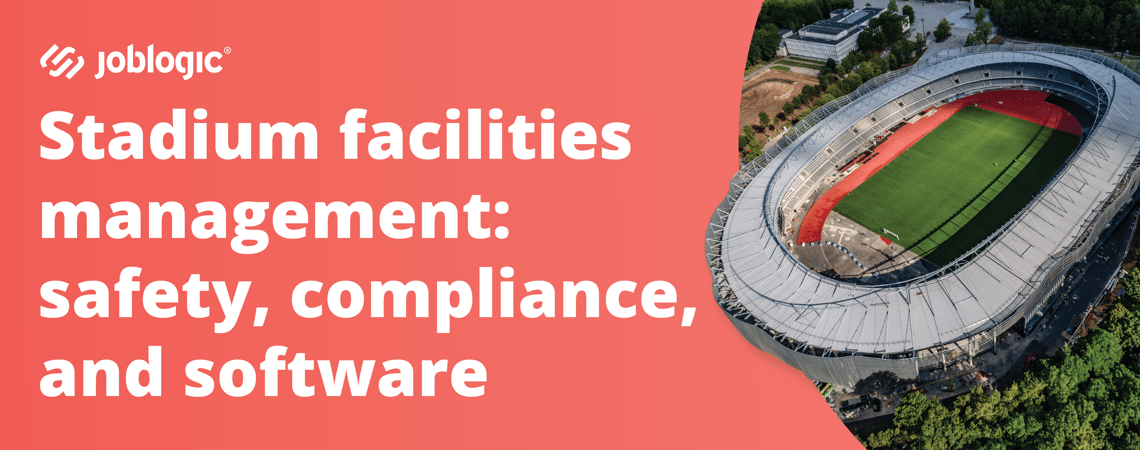
Stadium facilities management is not standard commercial FM applied to a bigger building. It combines the asset density of a large estate, the compliance obligations of a public venue holding thousands of people, and a fixed event calendar that leaves little room for anything to go wrong. Few other FM environments demand all three at once. An electrical fault in an office block means someone works by their phone torch for an hour. The same fault at a stadium halts a match or a concert altogether, and it's national news within the hour.
Strip away the fanfare and the matchday atmosphere, and what's left is still a massive estate requiring coordinated maintenance, safety, compliance, and operational services across hard services (mechanical, electrical, and structural infrastructure) and soft services (cleaning, catering, and security). A single stadium can span dozens of contractors and thousands of individual assets, each with its own maintenance demands, usage patterns, and compliance obligations.
Those spaces typically include:
- Pitch and playing surfaces: drainage, irrigation, and turf condition monitoring
- Spectator areas: seating, concourses, toilets, and accessibility infrastructure
- Hospitality and conferencing suites: climate control, audio-visual systems, and furnishings
- Back-of-house areas: plant rooms, kitchens, loading bays, and storage
- External grounds: car parks, signage, and perimeter fencing
Common sports facilities and their operational demands
Sports facility management extends well beyond football stadiums. Arenas, leisure centres, athletics tracks, and multi-use venues each carry different asset profiles, seasonal usage cycles, and regulatory requirements.
- Multi-sport arenas: switching between different sport layouts within a tight turnaround window
- Leisure centres: continuous public access with strict water-quality and ventilation standards
- Athletics stadiums: seasonal usage with long dormant periods requiring careful asset preservation
- Multi-use venues: converting between sport, concerts, and exhibitions without disrupting the underlying maintenance schedule
That scale and variety are exactly why an unstructured approach gets so costly, so fast.
Why structured facility management matters in stadium operations
Without a clear operational structure, maintenance teams default to reactive firefighting, responding to failures as they happen rather than preventing them. In a venue hosting thousands of people on any given day, the consequences of that approach go well beyond inconvenience.
Poor FM creates specific, compounding risks:
- Safety incidents: failing fire systems or emergency lighting puts large crowds at direct risk
- Compliance failures: missed inspections can trigger enforcement action or venue closure
- Certification risk: safety failures reviewed by the local Safety Advisory Group can jeopardise the General Safety Certificate a venue needs to admit spectators at all
- Rising costs: reactive maintenance consistently costs more than a planned visit would have
- Event-day failures: a critical system going down with no contingency plan can delay kick-off or force an evacuation
- Reputational damage: a bad matchday experience spreads fast on social media and puts season ticket renewals and sponsorship relationships at risk
Each unplanned callout carries higher labour costs, longer resolution times, and greater disruption than a scheduled service visit. When a job is logged with incomplete site details or the wrong asset attached, engineers arrive unprepared and the cost of that reactive visit climbs further. For a Finance Manager, that gap between planned and reactive spend is the first place margin pressure shows up.
The solution is a structured maintenance approach that separates planned work from unplanned demand and gives clear visibility across both, starting with getting the maintenance disciplines in order.
Stadium maintenance, safety, and compliance
Managing maintenance at a stadium means handling thousands of assets across multiple zones, each with its own service frequency and regulatory requirement. Effective delivery depends on three disciplines working in parallel: Planned Preventative Maintenance (PPM), reactive work order control, and compliance evidence capture.
Planned preventative maintenance and asset lifecycle planning
PPM covers the inspection and servicing of assets before they fail, based on manufacturer guidance, regulatory requirements, or condition data. In a stadium, PPM schedules are built around the event calendar so that major works fall in off-season or non-event windows. A well-structured contract underpins this: it defines which assets are covered, at what frequency, and to what standard, so nothing is left to assumption when the season begins.
Common PPM tasks in a stadium include:
- Fire alarm and suppression system testing
- HVAC servicing across hospitality and spectator zones
- Emergency lighting inspections
- Lift and escalator maintenance
- Pitch drainage and irrigation system checks
Asset lifecycle planning sits alongside PPM as a longer-term discipline. It helps forecast when assets will need replacing based on condition data, instead of waiting for a failure to force the decision at the worst possible moment.
Reactive maintenance and work order control
Reactive maintenance covers unplanned work triggered by equipment failure, damage, or urgent reports from site. In a stadium, a failure on event day carries immediate consequences for safety and operations, and the fallout doesn't stop at bad headlines: it can trigger a formal review by the venue's Safety Advisory Group.
Every reactive job should follow a structured work order process: logged, prioritised, assigned, tracked, and closed with evidence of completion. The quality of information captured at the point of job creation matters more than most teams realise. A vague description, a missing asset reference, or an incorrect site contact can delay the response and turn a straightforward fix into a repeat visit. Without that structure, costs are difficult to attribute, patterns of repeat failure go unnoticed, and it becomes nearly impossible to identify which assets are consistently underperforming.
This discipline also protects a Contract Manager commercially. If a client questions a reactive charge or an insurer requests documentation after an incident, a clean record of what was done, by whom, and when settles the question quickly.
Compliance, audit trails, and evidence capture
Stadiums are subject to extensive regulatory requirements covering fire safety, electrical testing, gas safety, water hygiene, food safety, and accessibility. Large grounds also fall under the Sports Grounds Safety Authority's Green Guide, the UK's dedicated standard for spectator safety, which underpins the General Safety Certificate required for grounds holding 10,000 or more spectators, or 5,000 or more for Premier League and Football League clubs. Compliance depends on capturing evidence at the point of work: photographs, signed-off forms, and certificates all attached to the correct asset record.
Key compliance areas to track include:
- Fire safety: alarm testing, extinguisher servicing, and emergency evacuation routes
- Electrical: fixed wiring inspections, PAT testing, and emergency lighting checks
- Water hygiene: Legionella risk assessments, temperature monitoring, and flushing regimes
- Gas safety: boiler servicing and gas tightness testing
- Food safety: kitchen equipment maintenance and extraction cleaning
- Accessibility: maintaining access routes, lifts, and facilities against the SGSA's Accessible Stadia standard
Audit readiness should be a by-product of how work is completed every day, not something rebuilt under pressure before an inspection. Capture the evidence at the point of work, and a clean audit trail is one click away, instead of pieced together from memory and email threads the night before an inspector arrives.
South Yorkshire Fire and Farnborough Airport both run on Joblogic, and neither can treat compliance as occasional. A fire service can't afford downtime on its own safety systems, and a major business aviation hub answers to some of the strictest regulatory oversight in the country. If the platform holds up there, it holds up against anything a stadium's compliance demands throw at it.

How facilities management software improves stadium operations
PPM, reactive control, and compliance evidence only work if the information behind them is reliable and accessible. Facilities management (FM) software brings jobs, assets, compliance, scheduling, and reporting into one system, instead of the same data living across multiple disconnected tools.
For stadium-scale operations, scattered spreadsheets and paper forms create gaps that grow with every new contract and every event. Missing evidence, unclosed jobs, and delayed invoices are almost always symptoms of information living in the wrong place, not of engineers doing poor work.
Scheduling, mobile workflows, and real-time updates
It's ninety minutes before kick-off and the PA system's down. A scheduling tool lets a Service Manager see who's nearest, what they're qualified for, and what they're already doing, and get the right engineer moving without a single phone call.
A mobile app puts job details, asset history, and compliance forms in an engineer's hand on site, not back in an office they haven't seen since morning. Evidence gets captured the moment the work happens, not typed up from memory that evening, which is exactly when a certificate goes missing.
Real-time status updates mean the office always knows whether a job is in progress, completed, or needs follow-up, so a small office team can coordinate a large field workforce without constant interruption.
Reporting, dashboards, and stakeholder visibility
A governing body wants proof every compliance certificate is current, three days before a cup final. An Operations Director who can pull that from a single dashboard is in a different position entirely from one still chasing spreadsheets. Live visibility into first-time fix rates, open job counts, compliance status, and cost per asset means club operations, event organisers, health and safety teams, and governing bodies can all see the same picture, without a single manually compiled report.
| Area | Manual approach | Software-led approach |
|---|---|---|
| PPM scheduling | Calendar reminders and memory | Automated schedules with engineer allocation |
| Job tracking | Spreadsheets and phone calls | Real-time status on a single dashboard |
| Compliance evidence | Paper forms filed in folders | Digital forms attached to asset records |
| Stakeholder reporting | Manually compiled reports | Live dashboards and portal access |
Reporting is only as reliable as the data feeding it. Capture evidence consistently and close jobs correctly, and the dashboard tells you the truth. Skip that discipline, and it just tells you a story.
Sustainability and waste management for large venues
A full house leaves and the bins tell the story of the night: plastic cups, food packaging, programme after programme, all needing somewhere to go. Good FM in a modern stadium now extends to environmental performance, and governing bodies and local authorities increasingly require venues to report on sustainability alongside standard operational compliance, with that expectation becoming part of contract requirements.
A Computerised Maintenance Management System (CMMS) can schedule and track maintenance of sustainability-related assets, such as solar panels or rainwater harvesting systems, alongside all other planned work, using the same evidence capture and audit trail as everything else.
Key sustainability focus areas for large venues include:
- Waste segregation: separating organic, recyclable, and residual streams at source
- Energy monitoring: tracking consumption across lighting, HVAC, and catering systems
- Water management: monitoring usage and maintaining harvesting or recycling systems
- Environmental reporting: sharing performance data with governing bodies and event organisers
Treat sustainability as part of the standard maintenance programme instead of a separate reporting exercise, and it stays manageable alongside everything else.
How Joblogic supports stadium and large venue FM
Joblogic's stadium facilities management software brings the disciplines covered in this guide, PPM scheduling, reactive work order control, compliance evidence, and subcontractor coordination, into a single platform built for large, complex estates rather than a single site. That gives an FM Contract Manager visibility across the whole operation, not just one contract at a time.
Assets can be tagged with QR codes for instant access to service history, maintenance schedules, and warranty information on site, which matters when a venue is tracking thousands of individual items across multiple zones. Subcontractor allocation is managed by trade and skill set, with compliance documentation captured through the same mobile forms logbook engineers use for every other job.
Arsenal's Emirates Stadium. Twickenham, home of English rugby. Harlequins' own ground, the Stoop. What happens on the pitch sets the standard, but the experience off it has to match. Thousands of people walk through the gates every week expecting a quality product and a comfortable way to enjoy it, and Arsenal FC, England Rugby, and Harlequins Rugby all use Joblogic to help deliver it.
Book a demo with one of our specialists, who can walk you through the platform and show you exactly how it fits your venue.

Frequently asked questions
What is the difference between stadium FM and standard commercial FM?
Stadium FM involves specific pressures that standard commercial buildings do not face. These include crowd safety obligations, seasonal maintenance windows, and multi-stakeholder reporting to governing bodies and event organisers.
How does CMMS software support stadium compliance?
A CMMS stores compliance evidence against each asset record and sends automatic reminders before inspection deadlines. Engineers capture certificates as part of closing each job, so the audit trail builds as work progresses instead of being reconstructed before an audit.
What qualifications do stadium facilities management professionals typically need?
Most roles require a background in FM, building services, or engineering, often supported by IWFM membership or health and safety qualifications such as NEBOSH or IOSH.
How do you plan stadium maintenance around a busy events calendar?
PPM schedules are built around event dates so major works fall in non-event windows. A reactive job gets triaged by whether it threatens event-day safety or operations right now, or can wait for the next gap in the calendar.
Can one system manage both planned and reactive maintenance in a stadium?
Yes. A platform that combines PPM scheduling with reactive work order management gives a single record for all maintenance activity, removing the need for separate tools and making reporting far more reliable.