Enterprise
Across dozens of sites, one local failure can become a problem for the whole group. A framework client can decide to walk away long before head office knows anything went wrong.
See how enterprise teams spot risk early
Challenge · Risk and reputation protection
One missed certificate, one engineer’s bad day, one complaint that reaches the wrong person, and years of reputation are on the line. You rarely see the risk building. You find out when a client questions renewal, an insurer asks a question, or a regulator gets involved.
Joblogic ties each job, certificate and signature to a record of what happened, across every site and team size. You see which contracts, sites or engineers carry risk, before a client or regulator finds it first.
Across dozens of sites, one local failure can become a problem for the whole group. A framework client can decide to walk away long before head office knows anything went wrong.
See how enterprise teams spot risk earlyAs the team grows, one engineer’s off day or one missed SLA is enough to put a client relationship built over years at risk, and you don’t always hear about it until the client’s already decided to leave.
See how growing businesses spot risk earlyFor a small team, reputation is personal: you’re the name on the van and the name a client remembers if something goes wrong, and there’s rarely a record behind you to prove you did the job right.
See how small businesses spot risk earlyEnterprise

A single site’s safety failure or missed compliance record doesn’t stay local once a client, a journalist or a regulator picks it up. The business ends up defending its whole reputation for an incident it may not know about yet.

When leadership asks which sites, contracts or subcontractors carry the most compliance or service risk, the answer is a guess built from whichever region reported in most recently, not a picture of the whole business today.

A framework client’s periodic review turns up a site with weak evidence, an expired certificate or a pattern of complaints nobody at head office could see, and the contract that’s cancelled can be the one the business assumed was safest.
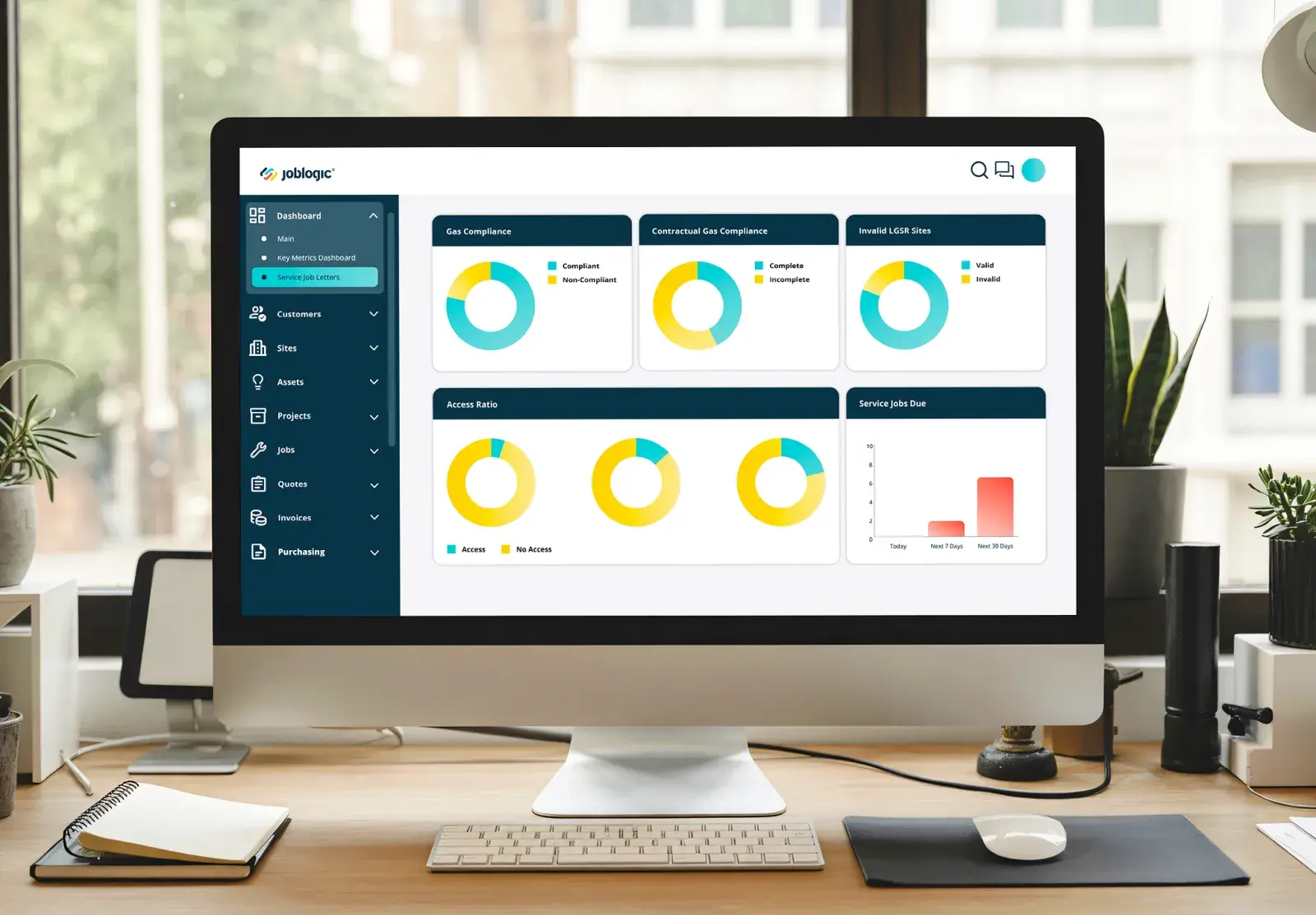
Complaints, SLA breaches and certificate status roll up from every site to one dashboard, so leadership sees where exposure sits before a client or regulator raises it.
Subcontractor work is recorded to the same standard as your own engineers’, so when the board asks which sites, contracts or subcontractors carry the most risk, the answer comes from the record, not a guess.
Each framework contract carries one set of evidence and SLA requirements, applied to every site under it, so a review finds the same record at each one and no site quietly runs its own version.
We’ve grown from £5 million to £20 million, and Joblogic has scaled with us the whole way. It’s never held us back.
One conversation about your operation. A clearer view of what comes next.
Growing business

Your best engineer handles a job one way and gets a five-star review. A newer engineer handles the same type of job differently, and the client remembers that visit, not the average.

A single late arrival on a priority contract, and the client’s account manager starts asking questions that never used to come up, because the relationship used to run on trust alone.

A customer complains to the office, the office resolves it and moves on, and you find out weeks later, if you find out at all, right around the time the client decides not to renew.
Engineers complete the same job sheet, photos and signature included, so the record of a visit looks the same whoever turned up.
Missed SLAs and repeat visits roll up into one view across the team, so you spot a pattern building before it reaches a client’s account manager.
Complaints are recorded against the job and the engineer, so you hear about them from your own system, not from a client who has already decided not to renew.
Being able to automate certificates and tie them to jobs and assets means we can answer compliance questions straight away.
One conversation about your operation. A clearer view of what comes next.
Small business

When a customer disputes what happened, or claims you damaged something you didn’t, you’ve got your memory and theirs. Without a signed record of the job, it’s your word against a client who’s already decided you’re at fault.

If most of your new work comes from word of mouth, one job that goes wrong and gets talked about locally costs you more than the job itself. There’s no marketing budget big enough to undo that conversation.

When you sign off a gas certificate or a safety check, you’re the one answering for it if it’s ever challenged. If you can’t produce the record fast, the other side can assume it never happened.
The engineer records what they did, with photos and a customer signature, before they leave site. That job sheet becomes the record you’d need if the work is ever questioned later.
The customer gets told when the engineer’s on the way and when the job’s done, so a delay reads as an update they received, not a complaint waiting to happen.
The certificate is completed and saved against the job and the customer when it’s signed off, so it’s ready to produce when a client, insurer or inspector asks for it, not buried in a file.
We’re saving thousands of hours every year on paperwork alone. That time goes straight back into serving clients better.
One conversation about your operation. A clearer view of what comes next.
If your reputation rests on your own word, start with Standard. Once a bigger team shares it, Premium adds consistency. Multi-site groups get the whole-business view with Enterprise.
Suits a small team whose reputation rests on one person’s word, with no formal system yet behind the work to back it up.
Covers signed job sheets, certificates and customer updates at the point of work, so you have a record of what happened if a client or insurer ever asks.
See how Standard handles riskFits a growing team where a wider group of engineers means one weak link can undo a client relationship built over years.
Standardises job evidence and complaint reporting across the whole team, so a bigger headcount doesn’t mean bigger inconsistency.
See how Premium handles riskSuits multi-site operations where one site’s failure can put a whole framework contract, and the group’s name, at risk.
Adds dashboards and one evidence standard across sites, subcontractors and contracts, so leadership sees exposure before a client or regulator does.
See how Enterprise handles riskProcurement frameworks are re-tendered on documented performance, so one service failure with no record behind it can end the contract, not just prompt a complaint.
See how it works in the public sectorSafeguarding and duty-of-care expectations mean a missed maintenance visit becomes a parent or governor complaint, not just a scheduling gap.
See how it works in educationA hygiene or equipment failure is visible to customers straight away, so a lapsed service record can become a public reputation problem fast.
See how it works in catering & hospitalityA missed asset service can halt a production line, so the downtime claim that follows lands on your maintenance record, not only on the client’s.
See how it works in manufacturing and logisticsA venue safety failure happens in front of a paying crowd, so the last inspection record becomes the first thing anyone asks for.
See how it works in sports and entertainmentEvery job sheet, photo and signature taken on site is stored against that job, timestamped and attributed to the engineer who completed it. If it was captured through Joblogic, it’s retrievable; anything from before you started isn’t.
It gives you a record of what was agreed, what was done and who did it, which is the evidence you’d need to defend yourself. It doesn’t replace insurance or legal advice, it supports the case you’d need to make.
Job evidence, certificates and customer communication follow the same process whoever’s on site, so the record looks the same regardless of which engineer did the work. It won’t fix an engineer’s technical standard, only the consistency of what’s recorded around it.
Complaints, missed SLAs and repeat visits roll up into one view, so a pattern across several jobs is visible before it reaches a client escalation. It’s current reporting, not prediction, so it shows what’s already happening, not what’s about to.
Site-level complaints, SLA breaches and expired certificates roll up into a group dashboard, so a pattern at one site is visible at head office in the same reporting cycle, not months later at a client review.
Subcontractors working under a contract log evidence into the same system and process as your own engineers, so their risk becomes visible rather than hidden inside separate paperwork. It’s only as complete as what each subcontractor actually logs.
It depends on where the exposure sits. Standard covers proof of work for a small team. Premium adds consistency across a bigger group of engineers. Enterprise adds group-wide visibility and one enforced standard across sites and subcontractors.
Records are reliable from the first job logged after go-live. Historic incidents, certificates or complaints aren’t automatically included, so what you can prove about anything before that date depends on what existed and how it’s migrated.
Bring a recent complaint, audit or near-miss to the call. We’ll show you what proof would have existed, and what would still be missing, against how you work today.