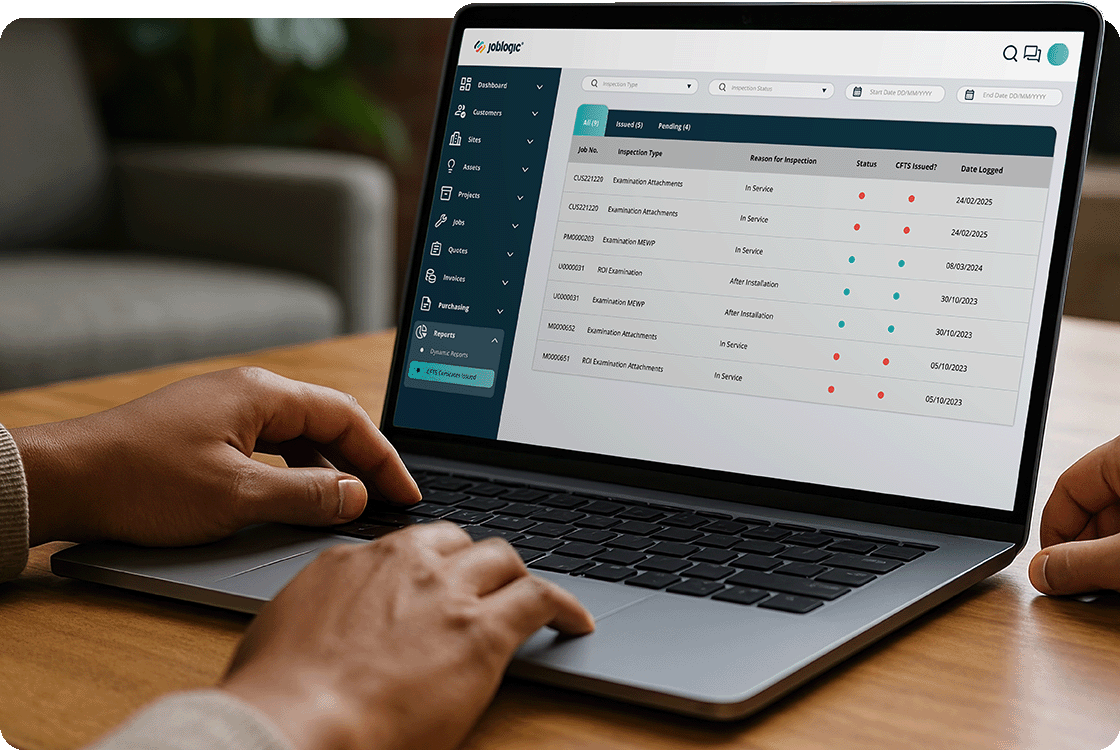
Certificates nobody can find
A client calls for proof of last quarter’s lighting test, and the certificate is in an inbox, a filing cabinet, or an engineer’s van, not to hand.

Fire safety
Fire safety work runs on dates, not jobs: quarterly lighting tests, six monthly extinguisher services, annual risk assessment renewals, each tracked against a different site on a different cycle. One missed date on a spreadsheet becomes a certificate nobody can produce when the client asks.
Joblogic gives fire and life safety contractors one system for test dates, certificates, and remedial quotes. Service managers see what’s due before it lapses, operations managers schedule specialist engineers to the right site, and finance managers invoice remedial work the day it’s completed.

The work runs on test dates and certificates, and one missed cycle is what an inspector finds first.
A client calls for proof of last quarter’s lighting test, and the certificate is in an inbox, a filing cabinet, or an engineer’s van, not to hand.
A lighting test or extinguisher service slips past its window before anyone notices, one cycle among dozens of sites, each running to its own schedule that no spreadsheet is watching closely enough.
A fire risk assessment runs out quietly in the background of a busy contract, and it only surfaces again when a tenant, insurer or fire officer asks to see it.
An engineer flags a faulty call point on site, and the remedial quote takes days to raise because it starts from a blank form, not the job that found it.

Forms and certificates attach to the job and the asset, so the record is there when a client or inspector asks for it.

Drag fire safety jobs onto the calendar, see who is free, and move or batch-deploy jobs between engineers in one action.

Automated email and SMS updates and a customer portal show job status, documents and quotes, so customers stop chasing you.

Photos, signatures and time-stamped GPS locations give you a clear record of what was done, where and when.
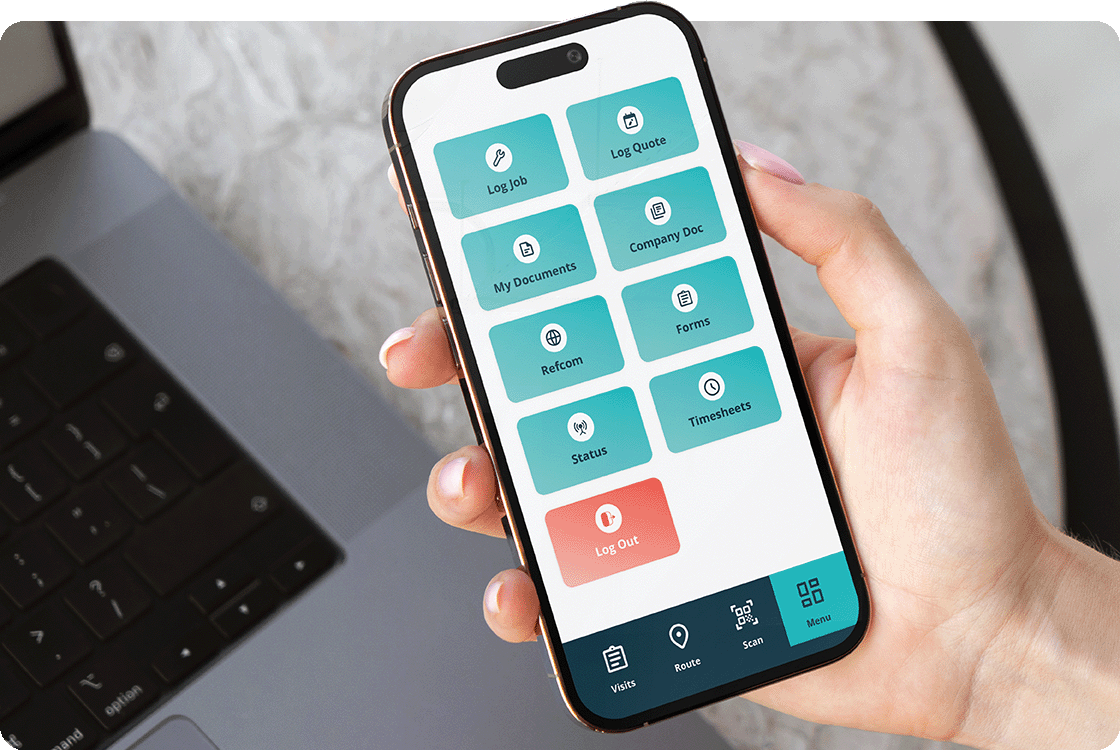
Job sheets, photos, signatures and forms are completed on the mobile app, so nobody drives back to the office to drop off paper.
Test dates, certificates, assessments, and remedial quotes sit in one place, so no site depends on someone remembering.
Certificates and test records are stored digitally against the site, and clients get their own access. A certificate request stops being a phone call to your office.
PPM schedules trigger the next lighting test or extinguisher service automatically, per site, per frequency. A missed cycle shows up before the window closes, not after.
Each site and asset carries its own risk assessment expiry date, with alerts as renewal approaches. A lapsed assessment stops being something you find out about from someone else.
A remedial quote builds from the job that found the fault, using pre-set templates and pricing. What used to take days to raise goes out the same day.
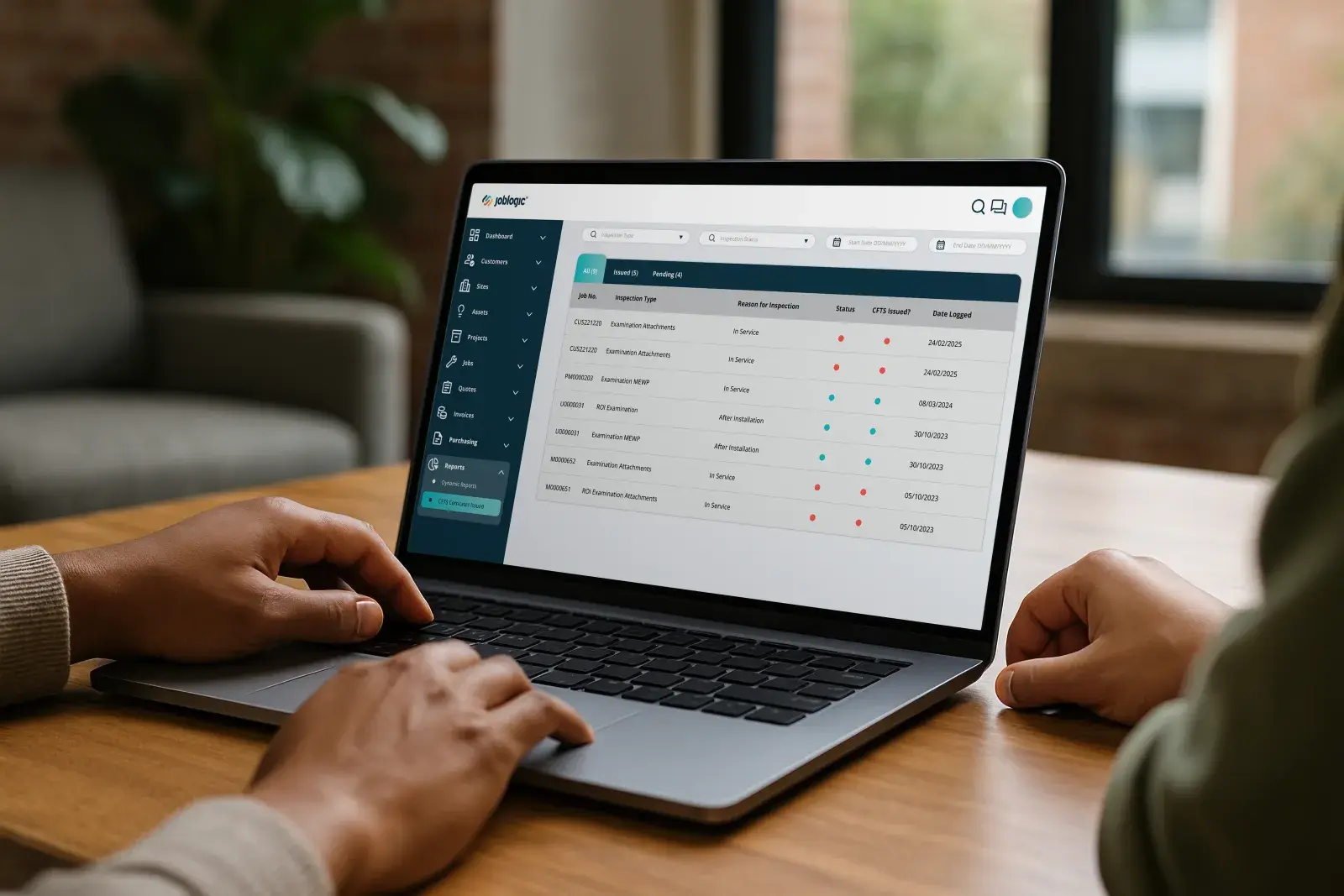
One dashboard shows test status, certificate expiry and remedial work across every site and contract, so oversight doesn’t depend on chasing five spreadsheets.
Every certificate, test result and risk assessment attaches to the site as the engineer completes it, stored digitally against BS 5839, BS 5306, BS 5266 and the Fire Safety Order.
When the Responsible Person, insurer or fire officer asks for proof, you export the record instead of rebuilding it. The afternoon spent finding a certificate stops happening.
We’re saving thousands of hours every year on paperwork alone. That time goes straight back into serving clients better.
Who this touches depends on how big your operation is. A two-engineer fire safety firm runs everything through one person; a national contractor covering hundreds of client sites splits it across a full team.
You run compliance, scheduling, and billing yourself. Joblogic keeps every test date, certificate, and remedial quote straight even when you’re the only one keeping track.
See how it works for ownersSchedules specialist fire alarm, suppression, and extinguisher engineers across sites and contracts, and replans the day when an urgent callout lands on top of a planned PPM round.
See how it works for operationsTurns a completed remedial job into an invoice the same day, instead of chasing paperwork from an engineer’s van a week after the work was done.
See how it works for finance leadersYou walk into a framework contract renewal needing a full history of test dates, certificates, and risk assessments, not a scramble. Joblogic builds that record automatically, site by site.
See how it works for contract managersYou need every engineer’s fire alarm, suppression or extinguisher certification current and provable. Joblogic matches qualified engineers to the job and keeps that record against each person, not a spreadsheet.
See how it works for HR managers80% of Joblogic users work from the mobile app day to day, a figure that holds across the wider customer base, not fire safety exclusively. On a fire safety job that means the alarm test result and a photo of a faulty call point get logged on site, at the point the work happens, not written up later.

Works with the accounting and reporting you already use, and holds together whether you cover ten sites or ten thousand.
Connects to Xero, Sage, and QuickBooks, so invoicing for completed and remedial fire safety work reconciles without re-keying figures by hand.
Structured around the sites, framework contracts and client portfolios fire safety firms actually manage, not a generic branch or region model.
Built around BS 5839, BS 5306, BS 5266 and the Fire Safety Order, the standards a client audit or fire officer actually checks against.
Yes. Every certificate, test result and fire risk assessment attaches to the site and asset as it’s completed, and exports as a single record when a client, insurer or fire officer asks for it. There’s no rebuilding a compliance file from inboxes and vans on the day it’s requested.
Yes. Fire detection, suppression, emergency lighting, and extinguisher servicing all run through the same job, asset, and compliance record. You’re not logging into a separate system for each discipline, and a single site’s history covers every system fitted there, not just one.
Yes. Subcontracted engineers get a portal scoped to the jobs and sites you assign them. You see completion status and compliance documents as they’re logged, without opening the rest of your account to a business outside your own, and without chasing them for paperwork afterwards.
Yes. Every site carries its own test schedule, certificate history and assessment expiry, viewed together or site by site. Consistency doesn’t depend on one person remembering the renewal pattern for each individual client, so cover doesn’t slip when that person is away or moves on.
Both. The same test, certificate, and asset structure holds whether you’re a two engineer firm covering local sites or a national contractor managing hundreds of client contracts at once. What changes as you grow is the scale, not the underlying record or the way it’s built.
It replaces it. Jobs, PPM scheduling, compliance records and invoicing run from one system rather than a spreadsheet feeding a separate diary, so there’s one version of what’s due, what’s overdue and what’s already been done, not two versions that quietly disagree.
Yes. Reactive callouts get slotted into the schedule alongside planned testing rounds, so an urgent fault doesn’t mean the rest of the week’s PPM visits quietly slip. The planner sees both types of work on the same screen, not two separate diaries to reconcile by hand.
Thirty minutes on your own contracts: how test dates and certificates get tracked per site, how remedial quotes turn around same day, and how engineers capture compliance evidence on the mobile app.