 Live Chat



.png)




Written by: Paul Webb
Stop thinking like a contractor.
Start thinking like a service business.
After twenty years working with field service businesses, I’ve noticed something.
The ones that struggle don’t usually struggle because the work is bad.
Their engineers are capable. Customers are calling. Jobs are getting done.
What breaks is the thinking.
And it almost always breaks at the same moment.
Early on, the contractor mindset works beautifully. Someone rings. You respond. You fix the issue. You invoice. You move on. It’s direct. It’s satisfying. You’re close to the work, close to the customer, and nothing gets lost because it’s all happening inside your head.
But then the business grows. Not dramatically. Just enough.
- Enough engineers that you can’t be everywhere.
- Enough jobs that you stop remembering every site.
- Enough customers that things start overlapping.
That’s when the cracks appear.
At first, it feels like pressure, not failure.
You’re busier than ever, but somehow always chasing. Engineers are stretched. The office is following up on paperwork that should already exist. Compliance is “nearly done” more often than it’s actually finished. Cashflow lags behind work you know has been completed.
Growth stops feeling exciting and starts feeling heavy.
When good habits become liabilities
When I see this pattern, it’s rarely about people or effort. It’s almost always because the business has outgrown a contractor mindset but hasn’t realised it yet.
Here’s the difference I’ve seen again and again.
Contractors think in jobs. Service businesses think in journeys.
A contractor wakes up asking, “What’s today’s callout?” whereas a service business asks, “Where is this customer in their lifecycle?”
That sounds subtle. It isn’t.
One mindset focuses on finishing the work in front of you.
The other focuses on making the next piece of work easier, cleaner, and more predictable.
Neither is wrong. But only one of them scales without burning people out.
Most of the pain I see in FSM businesses doesn’t come from bad decisions. It comes from habits that made perfect sense at ten engineers and quietly became liabilities at thirty.
Engineers do great work, but the knowledge stays in their heads. Asset history exists, but only if you ring the right person. Photos, notes, and certificates turn up eventually, after someone asks.
The office spends more time chasing information than using it and leaders can’t step away because things don’t quite run without them.
From the outside, everything looks fine. Jobs are being completed. Customers are being served. Underneath, though, the business is running on memory, goodwill, and heroics.
That’s fragile.
The shift from jobs to journeys
The strongest service businesses make a shift at this point. It’s not loud or dramatic, but it changes everything. They stop treating each job as a standalone event.
Instead, every visit becomes part of a longer story.
An asset’s history. A compliance trail. A customer relationship that spans years, not invoices. A financial flow that doesn’t stall because something went missing.
Once that lens changes, behaviour changes with it.
Photos stop being taken “just in case” and start being taken so nobody has to guess later.
Certificates stop being admin and become how a job is properly finished.
Data stops being reconstructed in the office and gets captured once, on site, where it’s accurate.
Ironically, this doesn’t add complexity. It removes it. Because when information flows properly, you stop doing the same work twice.
What this looks like in practice
You don’t see this shift in boardrooms or strategy decks. You see it on a normal Tuesday.
Engineers arrive on site with context, not questions. They log assets properly because it saves them time next visit. They finish jobs fully because they know it prevents call-backs and disputes. The system feels like support, not surveillance.
Managers stop firefighting missing information and start trusting the schedule. They can see what’s happening without chasing updates. Planning replaces reacting.
Office and finance teams receive clean job data the same day. Invoicing speeds up. Confidence in the numbers replaces hope.
And leaders, this is the biggest change, step back. Not because they care less, but because they finally can. They see patterns instead of anecdotes. Decisions get made on reality, not gut feel. Growth stops depending on a handful of people holding everything together.
Process should remove friction, not add it
This is why I push back when people say best practice slows them down.
Poorly designed processes slow people down.
Good ones do the opposite. They remove ambiguity. They reduce duplication. They protect engineers’ time. They protect the business when something goes wrong.
The difference is whether best practice lives in a document or whether it’s built into how work actually gets done.
When workflows are clear and consistent, people don’t need reminding. They just work.
Why service businesses scale differently
Growth under a contractor mindset feels chaotic. More work means more pressure. More customers mean more noise. More engineers mean more coordination problems.
Growth under a service business mindset feels different.
Work scales without admin exploding. New people are onboarded into clear ways of working. Knowledge doesn’t walk out the door at five o’clock. Compliance strengthens instead of cracking. The business becomes resilient, not because people are working harder, but because the design is better.
The question that reveals the future
Systems matter here, but not in the way most people think. No system fixes a broken mindset. I’ve seen too many try and ultimately fail.
But the right system can reinforce the right behaviours. It can make the good way the easy way. It can connect field, office, and finance so information moves once instead of being chased three times.
When systems align with how service businesses actually operate, adoption stops being a fight. People use them because their day gets lighter.
So this isn’t about eliminating reactive work. That will always exist.
The real question every growing FSM business eventually faces is simpler:
- Are we just getting through today or are we making tomorrow easier?
- If one key person stepped away, would things still run?
- If an engineer visited a site for the first time, would they feel confident?
- If an auditor asked questions, would you relax or tense up?
The most successful businesses I’ve worked with didn’t stop being contractors.
They just stopped thinking only like contractors.
They became service businesses by design, not by accident.
And once that shift happens, everything else starts to feel lighter.
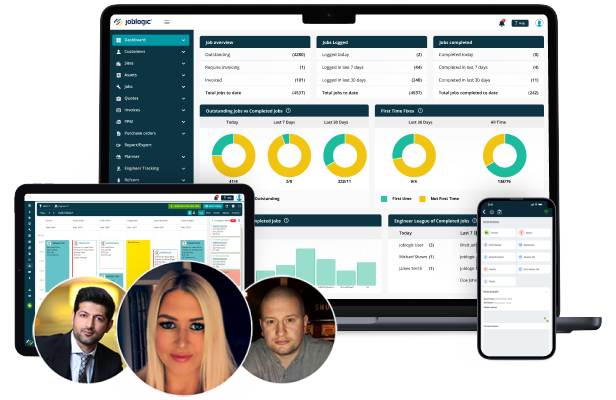
Book your free demo today!
Speak to our product expert to see how the Joblogic features fit your business
*No hard sell, no commitment