 Live Chat



.png)




Written by: Joblogic
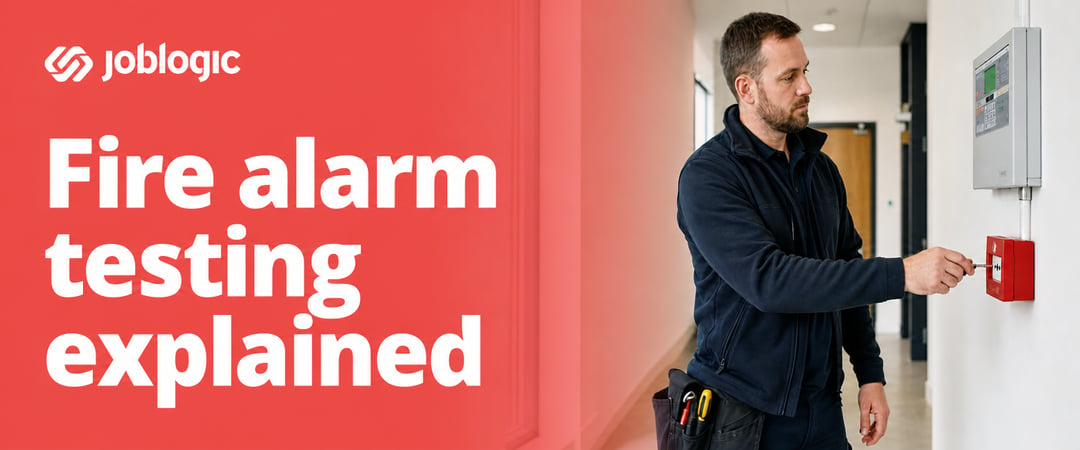
Fire alarm testing is the routine process of checking that a building's fire detection and warning system will work correctly in a real emergency. It covers manual call points (the red break-glass units mounted on walls throughout a building), sounders, and the control panel.
The UK standard that governs this is BS 5839-1, the British Standard for fire detection and alarm systems in non-domestic premises. It sets out what needs to be tested, how often, and by whom.
A compliant testing regime has two distinct parts: weekly checks carried out in-house by the responsible person, and periodic servicing by a competent fire alarm engineer. Both are required under BS 5839-1, and neither replaces the other.
Why weekly fire alarm testing matters
Faults in fire alarm systems rarely announce themselves. A sounder circuit may develop a high resistance, a battery may begin to degrade, or a detector may drift out of its sensitivity range, and none of these will be visible until the system is tested.
The Regulatory Reform (Fire Safety) Order 2005 (RRO) places a legal duty on the responsible person to maintain fire precautions in efficient working order. The responsible person is the employer, building owner, or whoever has control of the premises, and this duty cannot be passed on to someone else.
Failing to test regularly carries consequences beyond life safety:
- Legal: Non-compliance with the RRO can result in an Enforcement or Prohibition Notice from the local Fire and Rescue Service, or criminal prosecution where a failure places people at risk of death or serious injury, whether or not an incident occurs
- Insurance: Gaps in testing records can result in a reduced or refused claim after a loss, as many insurers require evidence of a maintained testing regime
- Audit exposure: The fire service or your insurer may ask to see your records at any time, and an incomplete log book offers no defence
Fire alarm testing regulations UK workplaces need to know
The legal framework for fire alarm testing sits across two documents. The RRO sets the obligation; BS 5839-1 sets the technical standard for meeting it.
BS 5839-1 is not a statute, but courts and insurers treat it as the benchmark for deciding whether a system has been properly maintained. Deviating from it without clear justification creates legal exposure.
The minimum requirements under BS 5839-1 are:
| Requirement | Frequency | Who carries it out |
|---|---|---|
| Manual call point activation | Weekly | Responsible person or appointed staff |
| Panel and indicator check | Weekly | Responsible person or appointed staff |
| Full system inspection and service | Every five to seven months (minimum twice yearly) | Competent fire alarm engineer |
| Full detector and device coverage | Annually | Competent fire alarm engineer |
Every test must be recorded in a fire alarm log book, kept on site at all times. Each weekly entry should include the date, which call point was tested, the result, and the name of the person who carried it out.

How to test a fire alarm call point each week
Weekly testing is an in-house task. You do not need a contractor to carry it out, and it should take no more than a few minutes.
The process involves activating one manual call point, confirming the panel responds correctly, and logging the result. You should rotate through all call points over time, so every device is proven across a series of weeks rather than the same unit being tested repeatedly.
Follow these steps each week:
- Notify your alarm receiving centre (ARC). If your system is monitored, inform the ARC before you start so no emergency response is dispatched.
- Choose a different call point each week. Rotating through all devices means every point is tested over the course of a few months.
- Activate the call point using a test key. Insert the key rather than breaking the glass to avoid unnecessary replacement.
- Check the control panel. Confirm the panel shows a fire condition in the correct zone for the call point you activated.
- Verify the sounders. Confirm sounders activate in the areas you would expect for that zone.
- Silence and reset. Silence the alarm at the panel, reset the call point, and confirm the system returns to a normal status display.
- Record the result. Log the date, the call point tested, the outcome, and any faults in your fire alarm log book.
If you find a fault, report it to a competent fire alarm engineer straight away. Do not wait until the next scheduled service visit.
How often should fire alarms be tested?
Testing frequency depends on the type of activity being carried out. In-house weekly tests and professional servicing serve different purposes and must both happen on schedule.
The minimum frequencies under BS 5839-1 are:
- Weekly: Manual call point activation and panel check, by the responsible person or an appointed member of staff
- Every five to seven months: Full system inspection and service, by a competent fire alarm engineer, in line with the flexible window introduced under BS 5839-1:2025
- Annually: All detectors and devices tested across the two service visits, so every device is covered at least once a year
Your fire risk assessment or insurer may require a higher frequency than the minimum, depending on the building's use, occupancy type, or risk profile. Always follow the most demanding requirement that applies to your premises.
Smoke alarm testing
Smoke alarm testing for domestic properties follows a different standard: BS 5839-6, rather than BS 5839-1. BS 5839-6 applies to individual dwellings, houses in multiple occupation (HMOs), and similar residential buildings.
For most domestic alarm grades, the guidance is to test each unit monthly by pressing the test button and confirming the sounder activates. Where alarms are interlinked, check that all connected units sound when one is triggered.
Keep the vents on each unit free of dust, replace any alarm that chirps continuously due to a low battery, and replace entire smoke alarms every 10 years. Engineers managing residential portfolios should note that the RRO still applies to the common areas of multi-occupancy buildings, meaning the BS 5839-1 regime applies in those shared spaces even where BS 5839-6 governs individual flats.
Managing fire alarm checks across multiple sites with Joblogic
Weekly testing in a single building is straightforward to manage with a paper log book. Across dozens of sites, the challenge shifts from testing to tracking: knowing which call point was tested and when, which sites are due for servicing this month, and where a fault was reported but hasn't yet been closed out. That's the specific gap Joblogic is built to close.
Joblogic's Job Management and Job Tracking tools let you schedule the weekly call point rotation and the periodic servicing visit as linked, recurring jobs against each site, so the servicing interval, five to seven months under BS 5839-1:2025, and the weekly test cycle both stay visible in one place rather than living in separate diaries or paper logs. For a Contract Manager running fire alarm contracts across multiple clients, that visibility is what prevents a missed weekly test or a late service visit turning into an SLA dispute.
When a weekly check turns up a fault, raising it as a job through Joblogic's Job Management captures the asset, the site, and the fault description immediately, rather than waiting for a verbal handover to reach the office. For a Service Delivery Manager, that's what keeps a single faulty call point from turning into a delayed contractor visit or a repeat trip because the engineer arrived without the right information.
Using Joblogic's Mobile Forms, engineers and appointed staff log each weekly test and each servicing visit directly against the site, with the date, the call point tested, and the outcome captured on the spot rather than written into a paper log book that has to be produced later. Asset Management keeps that record building over time, so if the fire service or your insurer asks to see your testing history, it's already there rather than something you have to go and find.
If you want to see how Joblogic supports fire alarm compliance across multi-site estates, book a demo and speak with one of our specialists who can walk you through the platform.

Frequently asked questions
After reading through the testing requirements and process, you may still have questions specific to your situation. The answers below address the most common ones.
What should you do if a weekly fire alarm test reveals a fault?
Log the fault in your fire alarm log book and report it to a competent fire alarm engineer straight away. An unresolved fault means your system may not be compliant with the RRO until it is fixed.
Can the responsible person carry out weekly fire alarm tests without hiring a contractor?
Yes. Weekly testing is an in-house task that requires no specialist qualification. Servicing and annual detector testing must be carried out by a competent fire alarm engineer.
What records are required after each weekly fire alarm test?
Your fire alarm log book must record the date, which call point was tested, the result, and the name of the person who carried it out. The log must be kept on site and available for inspection by the fire service or your insurer.
Does BS 5839-1 apply to residential buildings?
BS 5839-1 applies to non-domestic premises and the common parts of residential buildings with panel-based systems. Individual dwellings fall under BS 5839-6 instead.
How do you manage fire alarm testing records across multiple sites?
Joblogic's Job Management and Job Tracking tools schedule the weekly rotation and the periodic servicing visit as recurring jobs against each site, so nothing is overlooked. Using Mobile Forms, engineers and appointed staff log each test on the spot, feeding straight into a central compliance record instead of a paper log book that has to be chased down later.
Is a six-monthly service still required if weekly tests are being carried out consistently?
Yes. Weekly tests confirm the system is operational but do not replace the detailed inspection a competent engineer carries out at the required interval, every five to seven months under BS 5839-1:2025. Both are required, regardless of how well the weekly testing record is maintained.