 Live Chat



.png)




Written by: Admin
Facilities management is entering a more demanding era. Margins are tight, estates are getting more complex, and the industry is staring down a long-term skills gap just as AI and automation begin to reshape expectations.
For FM businesses, the challenge is no longer simply delivering the job in front of them. It is figuring out how to grow, modernise, and stay flexible, while preparing for a future that still feels only partly defined.
That is exactly the challenge Thermatic is tackling. Under CEO Joe Lyon, the business is setting out an ambitious growth plan to become the nation’s number one Technical FM provider across a number of target sectors, building a company that is more adaptive, even more people-led and better equipped for the next generation of FM.
What stands out in conversation with Joe is that this is not growth for growth’s sake. It is a clear attempt to build a more resilient kind of FM business, one that invests in apprentices, embraces predictive maintenance, improves from within and uses technology with more realism than hype.
Our Q&A with Joe Lyon, CEO of Thermatic
Q: You stepped into the CEO role in January, and Thermatic has some ambitious growth plans. What is your vision for the business?
It all starts with what we call our belief statement. We want people to feel it and buy into it. The phrase we use is “to be the difference in facilities management.”
That is our North Star. Everything we do aligns with that. The important distinction is that we are not trying to be different for the sake of it.
FM is still a pretty standard industry in a lot of ways. You are looking after buildings and the environments around them, you have engineers in the field, and while AI and automation will change parts of that world, the core of it is still about service, reliability and people.
For us, being the difference means putting people first. It means collaboration. It means working closely with partners like Joblogic, with our supply chain and with the customer base we support.
Internally, we even refer to our clients as key partners, because we want the relationship to feel more collaborative than transactional.
The bigger ambition is clear enough. We finished FY25 at £30 million in revenue. Over the next seven years, we want to get to £100 million. But more than that, we want to build value into the business in a way people can understand day to day.
Shareholders might look at EBITDA, but most people in the company are not motivated by that. They are motivated by improving what they do, making things better, streamlining work, removing friction and finding smarter ways to operate.
%20(1).webp?width=929&height=435&name=Thermatic%201%20Resized%20(1)%20(1).webp)
Q: That sounds strong in theory, but how do you actually turn a belief statement into behaviours people live by?
That is the difficult bit. Every leader would love a perfect answer to that question.
One of the biggest things we have tried to change is the mindset around mistakes. What we found historically was that people were not trying to be great at their jobs; they were trying not to make mistakes.
And when that is the culture, people become very safe.
They become conservative. They stop trying things.
So, we have tried to change that. As long as someone is not being negligent, and as long as the mistake comes from curiosity or creativity, then that is okay. We can learn from that.
If somebody tries something and it does not work, fine. Let us talk about what happened, what we learned, what we do not repeat, and what positives came from it.
That has been a big cultural shift for us. We want people to be curious. We want people to explore better ways of doing things. If you only ever optimise for avoiding mistakes, you never really improve.
Q: FM businesses are dealing with a lot of pressure right now, from tighter margins to more complex estates and rising expectations. What do you see as the biggest structural challenges ahead?
The pace of change, especially around AI, is right up there.
Everybody is learning something new about AI every day, but very few people really understand where its limits are, or what it is genuinely going to do in our world.
That creates a challenge for FM because we are being asked to integrate something we do not fully understand yet.
In some industries, AI is already very visible. You can see it in design, content, images, and video. In FM, the application is more nuanced. We are managing buildings. We are still dealing with physical assets and real environments.
So the question becomes: how do you apply something artificial to something very physical and practical?
AI will absolutely have a role, but I think it is going to be a slower and more painful evolution in FM than some people expect. There will be plenty of iterations.
There will be things that look promising and do not quite land. But eventually the sector will catch up and find the applications that really matter and make a difference.
Q: So where do you see the biggest opportunities for growth?
Everyone wants new business, but if you are only chasing new clients, you are almost resetting the clock every time. You are going back to a standing start.
The bigger opportunity is to take the clients you already know, where you already understand their estates and their needs, and help them evolve and grow.
That means moving them away from traditional planned preventative maintenance and reactive work, and towards a more predictive model.
A good example for us is the work we are doing around asset management and predictive maintenance. As buildings become more connected, and as sensors and telemetry become more embedded, the building starts to tell you how it is performing.
Instead of waiting for something to fail or servicing it on a fixed calendar cycle because governance says so, you can start to intervene earlier.
That is where FM gets really interesting. You can see pressure changes, performance dips, signs of stress in an asset. You can step in before failure.
In some cases, you can tweak how an asset is being used and extend its life significantly. That, to me, is where the future of FM sits. .webp?width=1920&height=900&name=Thermatic%205%20Resized%20(1).webp)
Q: There is a lot of talk about AI externally, but what about internally? How are you thinking about AI and automation inside the Thermatic business itself?
The honest answer is that we’ve had to learn a few lessons.
Our business has grown quickly, and we have had various leadership changes along the way. We have grown from a delivery perspective, from a client perspective and from a revenue perspective.
What we hadn’t done enough of was invest in our internal processes.
Last year we pushed a digital transformation initiative and looked at introducing more information and automation.
That was useful, but it exposed a problem: the house behind the front door wasn’t really in order. That is the trap. You can end up trying to automate broken processes.
We definitely saw that.
We looked at areas with high friction, like timesheet processing for engineers, where lots of different people were touching the same workflow and it was passing through multiple gates.
We tried to automate parts of that, but eventually realised we were just automating a messy process.
So this year the focus has shifted. First, we standardise the process. Then we automate it. Then we connect systems together properly, whether that is Joblogic on the front end or payroll software on the back end.
But you have to get the foundation in place first. Otherwise you are just speeding up the wrong thing.
Q: Do you think that is a Thermatic-specific challenge, or something FM businesses across the board are wrestling with?
I think it is industry-wide.
A lot of FM businesses are still shaped by the fact they were built and led by ex-engineers or ex-facilities managers. That brings a very practical mindset, which is useful, but it also leads to a certain way of solving problems.
The default is often: I see a problem, I fix it.
What we are starting to see now, especially in younger leadership teams and more emerging businesses, is a slightly different way of thinking. Instead of asking how quickly we can fix the problem, we ask how we stop the problem existing in the first place.
That is a real shift. It is also why some of the bigger players can struggle.
Large organisations can become very rigid. They have established models, established hierarchies, and lower appetite for risk.
We have the ability to test things, move faster, adapt and innovate around the needs of our customers rather than forcing them into a fixed model. At the same time we deliver the technical expertise they need.
And that matters. We are already seeing customers move away from the big, inflexible providers because they want something more responsive.
Q: With so much noise around innovation and new technology, how do you decide what is genuinely valuable?
We try to make it practical and structured. We have six pillars in the business:
-
People
-
Customer & key partners
-
ESG
-
Quality
-
Digital transformation
-
Health, safety and welfare
Each of those has an owner. Then we run an initiative internally called Bright Ideas.
Anyone in the business can submit an idea and attach it to one of those pillars. We review those every month with a small group, look at where the value sits, and then build project teams around the ideas that have real potential.
That matters because I definitely do not have all the best ideas. None of us at leadership level do. Some of the most useful improvements come from the people closest to the work.
If someone can say: “This process could work better if we changed X to Y, and it would save three hours a week,” that is gold. That is how continual improvement becomes real.
Q: One of the biggest macro issues affecting FM is the skills gap. Older engineers are phasing out and not being replaced fast enough. Are you already feeling that?
Yes, definitely. I think the gap is already here, and I think it is going to get worse over the next five to seven years, especially in technical FM.
One of the things we have talked about a lot is the importance of the multi-skilled engineer. Traditionally, FM has been heavily siloed. You had your electrician, your gas engineer, your AC engineer and so on. Everyone had their lane and stayed in it.
We are trying to move away from that. We have built a tiered structure in our engineering pool. Apprentices come in and become technicians. Technicians develop into engineers and multi-skilled engineers.
Beyond that, we have master engineers, the specialists with deep craft knowledge.
The goal is to route work through that structure intelligently. A lot of the day-to-day work can be handled by technicians and multi-skilled engineers, with the master craft engineers brought in when a deeper specialism is needed.
That is how we prepare for a future where the most specialist engineers become rarer, more expensive or retire altogether.
%20(1).webp?width=929&height=435&name=Thermatic%203%20Resized%20(1)%20(1).webp)
Q: But is that enough? It still feels like a finite number of people and a long training runway.
That is true. It is absolutely an investment, and we will not see the full benefit overnight. We have invested heavily in our junior workforce, knowing the return on that really comes in five years rather than next quarter.
There is some natural resistance to this investment because it doesn’t provide a solution to today’s problem. However, as a business we have full support from every corner, including the shareholders, to build a sustainable and successful business for the future.
What has been interesting is the reaction from engineers themselves. You get two very different schools of thought.
One is: a multi-skilled engineer will never be able to do what I do.
The other is: I want to teach this person everything I know.
There is not a lot of middle ground.
But this is also where predictive maintenance comes back into the conversation. My ideal future is not one where we just need more and more engineers. It is one where we reduce unnecessary callouts in the first place.
If a building can be monitored remotely, and if assets can be managed through performance data, then we can intervene earlier, sometimes remotely, and use our engineering resource in a much smarter way.
That is the future as I see it: remote monitoring, remote condition reporting, smarter intervention, and only sending the right person when it is genuinely needed.
Q: Attracting younger talent is clearly a huge part of that. How do you make FM feel like an attractive destination?
A few years ago, there was this sense that young people would rather build an identity or career entirely in the digital world than go into practical trades. Why pick up a spanner when you could go and do something online? That was the narrative.
What is interesting now is that AI has made the digital world noisier and harder to stand out in. In a strange way, that has created more interest in practical skills again.
People can see the value in having a tangible capability, something real.
I still think there will be a shortage. Culturally, we are a different country to where we were 40 years ago, and perceptions of labour have changed. But apprenticeships are helping, and there is more appetite for alternatives to the traditional university route.
Our approach is cohort-based. Every year, apprentices across the business join as a group, whether they are in engineering, finance, management or elsewhere. They learn together, share workshops, build a sense of identity and progress together.
That has worked well for us.
We take between six and twelve apprentices a year now, and over the past three years we have built up to that level. Retention has been around 75%, which we are pleased with.
The bigger test will come as we scale the engineering side further, but the principle is sound: bring people in properly, support them as a community, and give them a pathway.
Q: Finally, if Thermatic hits its seven-year plan, what role do you want the business to play in FM?
I want Thermatic to be known for driving positive improvement in the sectors we choose to serve.
We are already strong in retail. I would like us to become a major force in emerging sectors like purpose-built student accommodation and build-to-rent, and I would also like us to help improve more mature sectors such as education and healthcare.
What I do not want is for us to become a £100 million national provider serving thousands upon thousands of clients with no real focus.
That is not “being the difference.” That is just being bigger.
I would rather we pick our lanes, go deep, and genuinely improve those parts of the industry.
If we can do that, if we can help customers move towards predictive maintenance, build stronger engineering pipelines, embrace the right kind of innovation and keep improving continually, then we will have done something meaningful.
That is what success looks like to me.
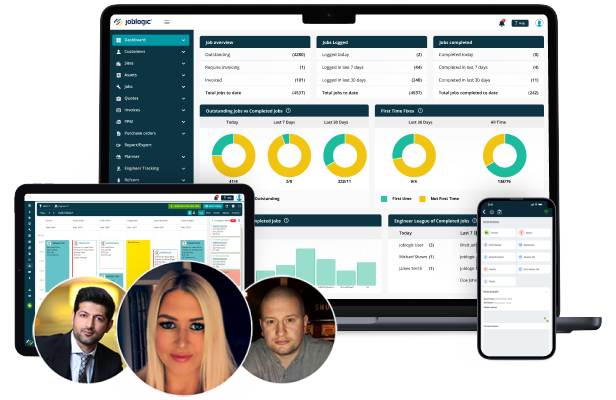
Book your free demo today!
Speak to our product expert to see how the Joblogic features fit your business
*No hard sell, no commitment