 Live Chat



.png)





How to improve job visibility across multiple sites
When service businesses expand to oversee multiple sites, operational weaknesses once absorbed by individuals begin to surface.
Job workflows start to drift, status definitions shift, and the system no longer reflects the full story of the work being done.
Common issues:
- Job status meaning different things depending on who updated it
- The next action sitting in an email or Teams conversation instead of the job record
- Meetings spent figuring out what's actually happening with work
- Someone needing to explain the job before another manager can pick it up
When this starts happening, the operation slowly becomes dependent on individuals rather than the system. What follows is not instant failure, but a slower, harder, more fragile way of working.
This article looks at why that happens, and what changes when growing organisations put clearer workflows in place.
What operational maturity looks like
Operational maturity is rarely visible in reports. It shows itself in how work moves through the system.
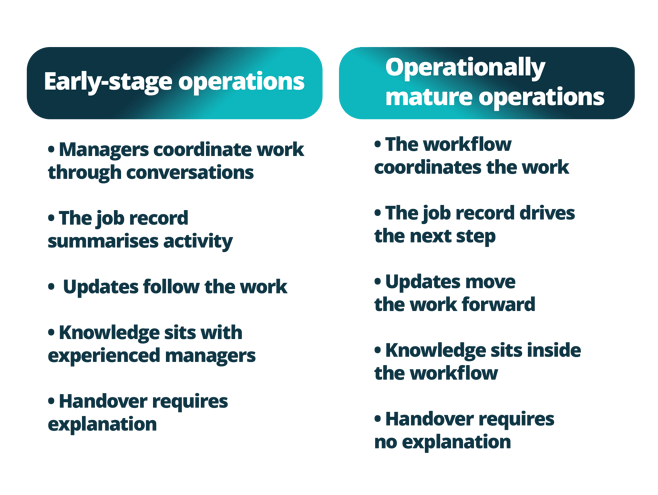
The system stops recording work and starts moving it.
The record stops reflecting reality
Can any operation be truly successful if you can't rely on your system to show job status?
A system only works when everyone uses it consistently. In most operations, the problem isn’t that teams ignore the system. It’s that conversations, contractor calls, and quick decisions move faster than updates to the job record.
At small scale, experienced teams can often compensate for these gaps. Managers chase updates, speak to contractors, and keep work moving. But as organisations expand across multiple sites, that kind of coordination becomes impossible to sustain.
Wayne Young, Head of Facilities Management at DB Cargo, oversees FM delivery in a complex, multi-site environment where visibility across jobs and next steps is critical.
“The first sign is when the system stops telling the story of the job. You open the record and the last update is days old, but in conversation people are saying things like ‘I spoke to the contractor yesterday’ or ‘that should be getting sorted.’ The activity is happening, but it isn’t being captured.”
At that point, the system is no longer guiding the work. It's simply recording parts of it.
“In progress” might mean different things across different sites. The real next step might sit in an email thread, a Teams conversation, someone’s notebook, or a spreadsheet used to track contractor updates.
Instead of guiding the work, the system becomes a partial record of it. The burden shifts to managers, who must interpret what’s happening with the job.
Nothing breaks overnight, but the operation becomes harder to manage.
The cost of relying on individuals
One managers become responsible for interpreting the status of work, the cost to the operation begins to grow.
The work itself rarely stops moving. Jobs still progress, contractors still attend site, and issues still get resolved.
What changes is how much effort it takes to keep everything aligned.
Managers spend more time interpreting the state of work, leaders lose confidence in the data, and progress slows whenever someone has to stop and clarify what is happening.
Three patterns tend to emerge.
Cognitive load
The first cost is cognitive.
When the status of work cannot be trusted in the system, managers have to verify it themselves. They check who last touched a job, confirm whether a contractor has been chased, and work out what “in progress” actually means.
None of these tasks move the job forward. They simply confirm information that should already be clear.
Over time this shifts how managers spend their effort. More time goes into interpreting the state of work, and less into progressing it.
Trust fragmentation
The second cost appears in leadership decision-making.
If job status depends on who last updated the record, confidence in the system begins to weaken. Leaders start relying on the people running the work rather than the data itself.
Reporting meetings shift from reviewing performance to interpreting updates. Forecasting becomes cautious rather than confident.
The system still contains the information, but it no longer provides a dependable view of the operation.
Delay by clarification
The third cost is delay.
Not because the job itself takes longer, but because someone eventually has to stop and ask a simple question:
What’s actually happening with this job?
In practice, this moment tends to appear in three situations:
“In most FM environments the trigger tends to be one of three things: time, reporting, or the customer. Either the job has exceeded the expected SLA, it appears on a dashboard that someone senior is reviewing, or most commonly the occupier asks for an update before the system provides one.
When that question comes and the answer isn’t immediately visible in the job record, it’s a good indicator that the process hasn’t been managed as tightly as it should have been.”
When the answer can't be found in the job record, the team has to reconstruct the situation through conversations and manual checks – which takes time and costs deadlines.
Balancing workflow and judgement
Variation is inevitable in service operations. The real question is whether it is designed into the workflow or handled informally by individuals. High-performing organisations address this through what can be described as a Default + Exception Map.
The Default + Exception map
Most work follows a defined workflow. A smaller portion requires variation.
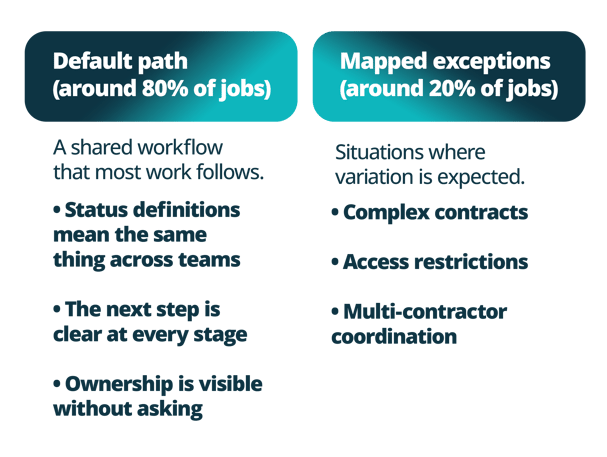
The difference here is that these variations are defined rather than improvised.
Managers can still adapt when the situation demands it, but the organisation maintains a workflow that everyone recognises.
The result is not identical processes everywhere. It is a system where work moves predictably, even when the situation varies.
What a good handover makes clear
If a manager was suddenly unavailable, could someone open any live job and immediately understand the situation?
The record should show what’s happened, who owns the next action, and what comes next.
If you still need to pick up the phone to get the real story, too much of the job still lives outside the system.
Wayne Young, Head of Facilities Management DB Cargo
“For me a good job record should tell the full operational story. Someone picking it up should be able to see what the issue was, where it occurred, what actions have already been taken, which contractor or team is involved, and what the next step is. Supporting information such as quotes, photos or permits should also sit alongside the record. If someone can open the job and quickly understand where it started, where it is now and what needs to happen next, then the handover works. If a phone call is still needed to fill in the gaps, the record isn’t doing its job.”
A well-designed workflow allows the job record to tell that story clearly.
Anyone should be able to open the job and immediately see its status and next step.
Growth demands transferable thinking
Relying on your best managers brought you this far, and they deserve credit for it. But as service organisations expand across multiple sites, that reliance becomes fragile. What once worked through experience, conversations, and personal coordination begins to strain as more teams, contractors, and locations become involved.
The workflow itself must carry the job forward, something most organisations only achieve when every stage of the job lives inside one intelligent platform that moves work, not just records it.
If that’s the kind of software your operation needs, book a demo with Joblogic today.